Most of what happens in AI is first explained in a newsletter. These are the ones worth an inbox slot — from daily digests to technical deep-dives, policy trackers and essayists — with who writes them and what they watch. Several are sources for the record's owncommentary rail. A listing is not an endorsement.
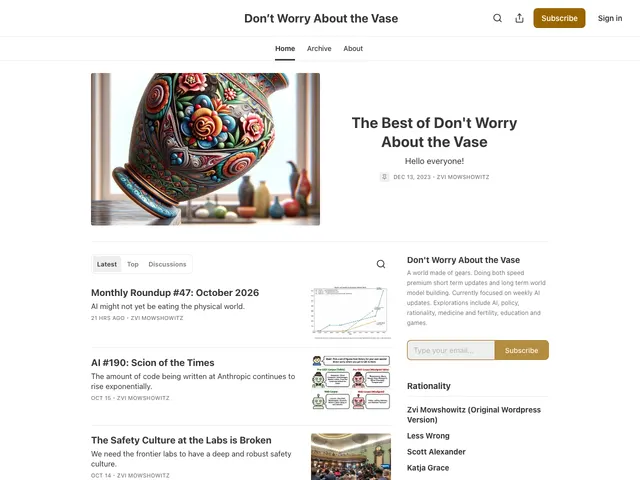
A general blog since 2018 that turned substantially to AI from March 2023, combining a flagship weekly links-and-commentary roundup with frequent standalone essays on model releases, lab strategy and the safety debate. Known for unusual length and granularity; posting volume rose sharply enough that a near-daily cadence is now typical.
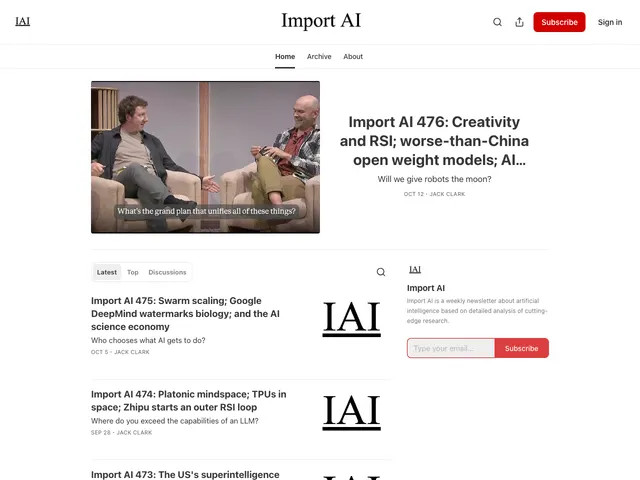
Jack Clark · Anthropic co-founder and head of policy
Numbered weekly issues mixing short AI research and policy summaries with Clark's own analysis, closing each edition with a short speculative-fiction vignette about where the technology might lead. One of the oldest continuously running AI newsletters, read widely inside labs and policy circles.
Independent research on semiconductors and AI infrastructure — chip supply chains, accelerators, datacentre economics and memory — widely cited by journalists and investors as a primary source on the hardware underpinning frontier AI. Free newsletter alongside paid institutional research products.
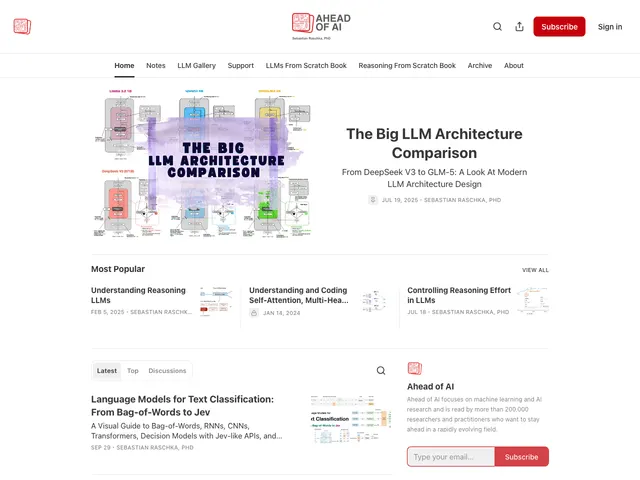
Sebastian Raschka · machine learning researcher and author
Deep technical explainers on machine learning research and methods — model architectures, training techniques, evaluation — written by a researcher and textbook author for readers who want the mechanics rather than the headline.
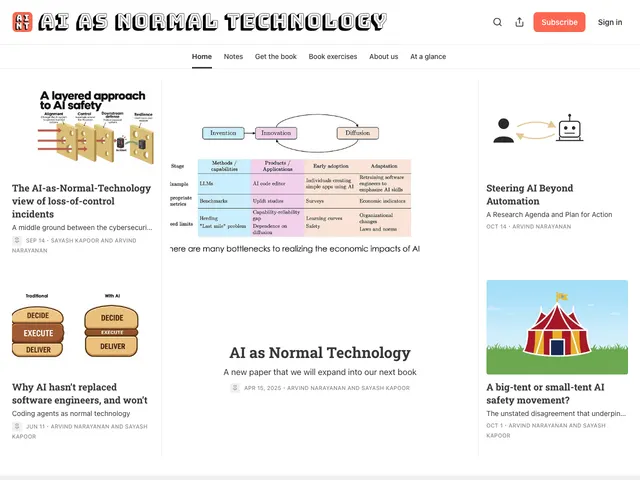
Essays arguing AI should be understood and governed as a gradually diffusing general-purpose technology rather than an imminent superintelligence, written by the authors of the book "AI Snake Oil" (the newsletter's earlier name, before its 2025 rebrand).
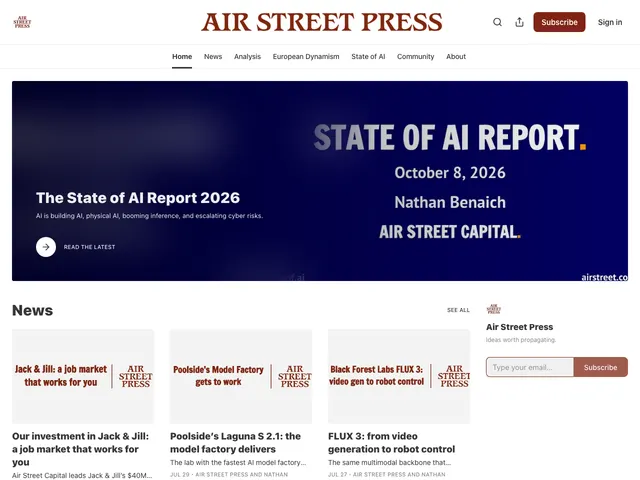
Nathan Benaich and the Air Street Capital team · venture capital investor and co-author of the annual State of AI Report
Newsletter from the venture firm behind the widely cited annual "State of AI Report", covering AI research, investment trends and the fund's own portfolio activity.
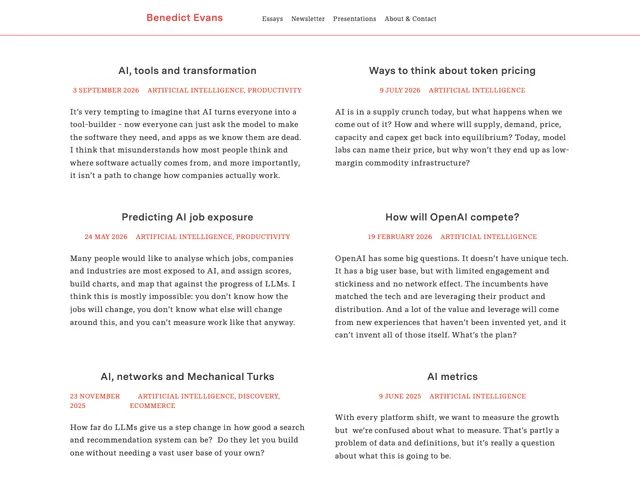
Benedict Evans · technology analyst, formerly a partner at Andreessen Horowitz
Weekly essay on what mattered in technology that week and why, increasingly centred on AI's business dynamics — pricing, competitive strategy, adoption curves and where value accrues — aimed at filtering signal from the broader tech-news cycle rather than covering it exhaustively.
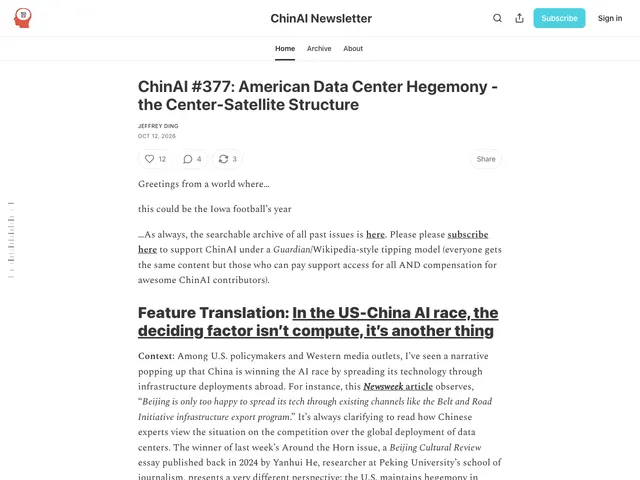
Jeffrey Ding · assistant professor of political science at George Washington University
Weekly translations of Chinese-language writing on China's AI landscape — policy documents, technical commentary, industry debate — selected and introduced by a political scientist who studies China's AI strategy. One of few English-language sources built on primary Chinese material rather than secondhand reporting about it.
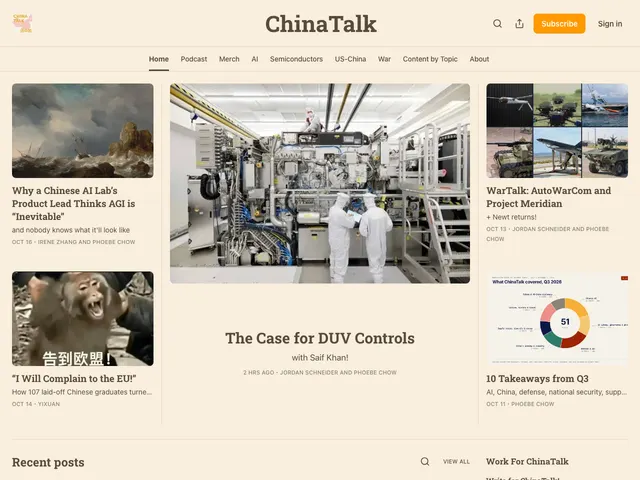
Jordan Schneider · podcast host and China-tech analyst
Interviews and essays on technology, China and geopolitics, with China's AI industry and chip-export controls a recurring subject; combines original reporting with conversations with policymakers, researchers and industry figures.
Primarily a long-form interview podcast with AI researchers and lab leaders, accompanied by the host's own written essays on topics such as scaling, continual learning and the limits of current models. The podcast is the main draw; the newsletter carries transcripts and essays.
Research institute's newsletter on AI trends, compute and training costs, benchmark performance and forecasting, grounded in the organisation's own datasets and models. Aimed at readers who want quantitative evidence rather than commentary; also carries a podcast, "Epoch After Hours".
Long-running weekly newsletter on technology's effect on the economy and society, with AI as a central and recurring subject since 2022. Most of the archive is paywalled; free editions tend to be broader essays rather than the numbered weekly round-up.
Nathan Lambert · machine learning researcher at the Allen Institute for AI (Ai2)
Technical newsletter on language-model post-training, RLHF and open-weight model releases, written by a researcher who has worked on open reproductions of frontier training recipes. Aimed at practitioners rather than a general audience; frequent "Artifacts" posts round up new open models.
Podcast and newsletter for AI engineers, pairing long interviews with lab researchers and founders with write-ups of model releases and tooling. A sister daily digest, "AINews", covers the news cycle the podcast doesn't have time for.
Practice-oriented newsletter on using large language models in work and education, written by a management professor who tests new models and tools directly and reports what does and doesn't work. Began under a management/innovation remit; turned to AI from 30 November 2022.
Essays on AI safety and alignment for a general audience, written by a safety researcher and a journalist who try to explain why some researchers worry about advanced AI without assuming prior familiarity with the field.
Casey Newton · technology journalist, formerly of The Verge
Original reporting and analysis on AI, social platforms and the companies and executives shaping them; AI has become a large share of recent coverage (OpenAI, frontier-lab safety) but the publication also covers X/Twitter, Meta and the broader tech industry.
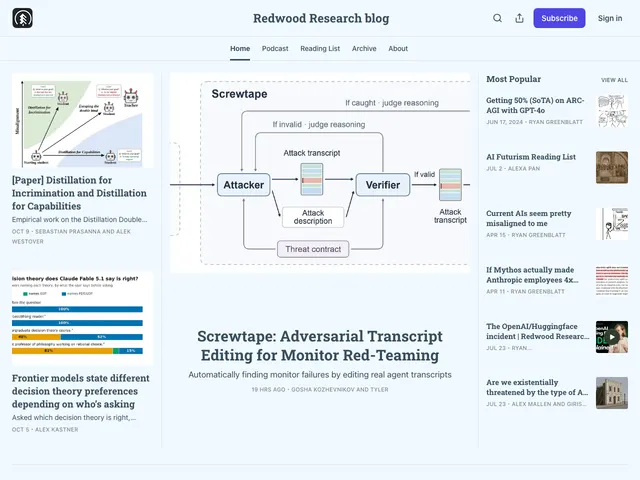
Technical blog from an AI-safety research nonprofit, covering work on AI control, monitoring for deceptive or misaligned model behaviour, and evaluation methodology, including joint work with Anthropic on "alignment faking". Aimed at AI-safety researchers and lab staff.
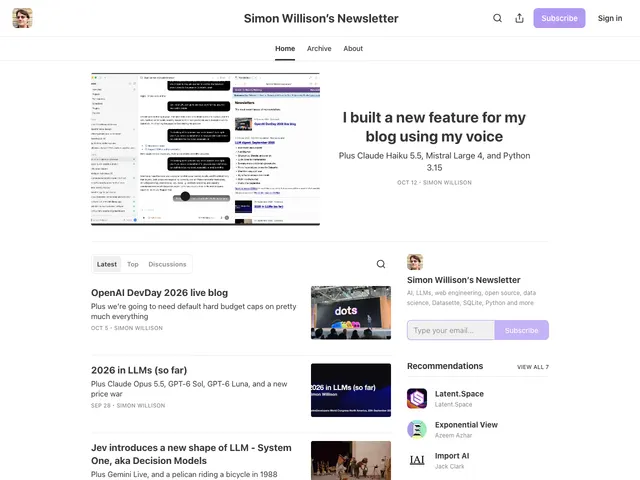
Simon Willison · software developer, co-creator of the Django web framework and creator of Datasette
An email edition of Willison's blog on large language models and the tools built on them: hands-on notes from testing new model releases, coding agents and prompt-injection risks. Written for developers who build with the models rather than for investors or policymakers.
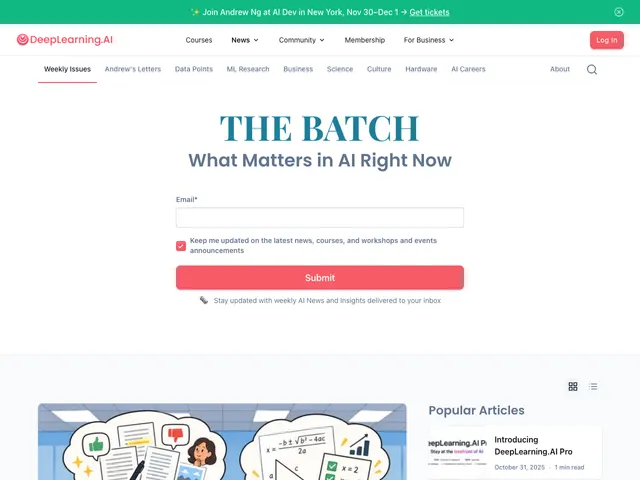
DeepLearning.AI · Andrew Ng's AI education company; Ng writes a regular "Andrew's Letter" column within it
Weekly digest of AI news, research and business developments from Andrew Ng's AI education company, aimed at practitioners and students; each issue pairs short write-ups of the week's stories with Ng's own column.
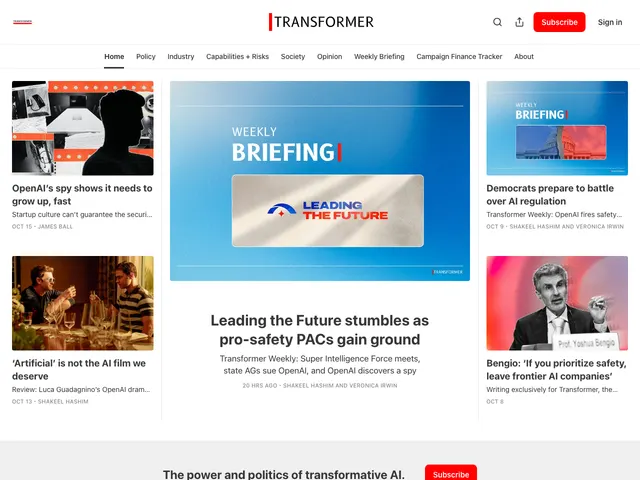
Shakeel Hashim, Veronica Irwin and contributors · independent AI journalists
Independent AI-news publication combining a weekly policy-and-industry roundup ("Transformer Weekly") with standalone reported pieces and opinion essays on AI safety, regulation and the companies building frontier models.
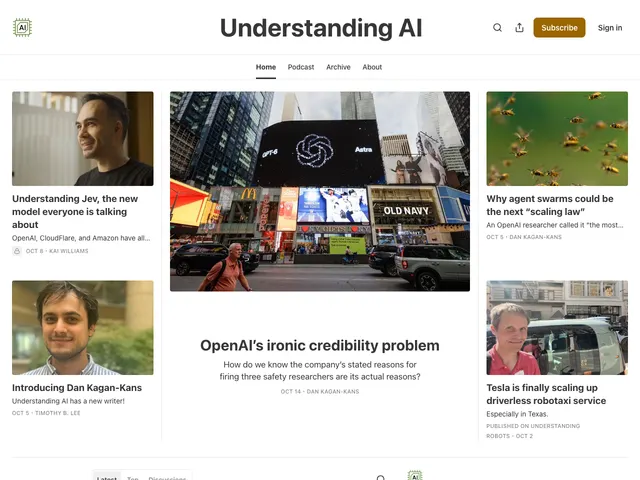
Timothy B. Lee and Dan Kagan-Kans · Lee is a technology and economics reporter, formerly of Ars Technica
Explanatory journalism on how AI systems actually work and what their technical limits are, written for readers who want mechanism rather than hype or alarm; covers both frontier labs' claims and critiques of them.
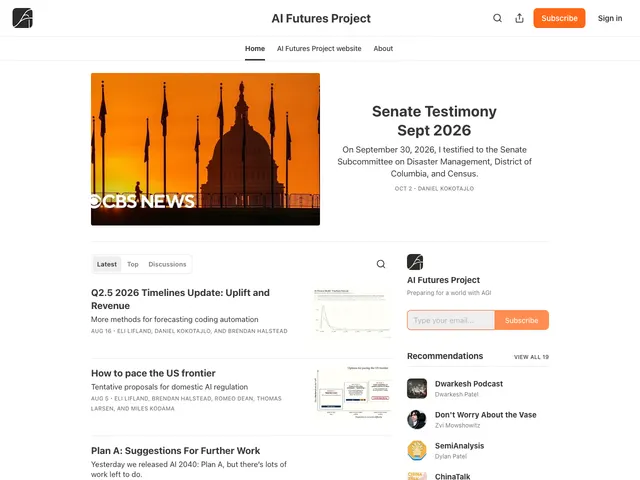
Daniel Kokotajlo and colleagues · former OpenAI governance researcher
Blog of a small research nonprofit that produces detailed scenario forecasts for how advanced AI might develop, including the "AI 2027" and "AI 2040" projects and an interactive forecasting model, plus commentary and testimony to policymakers.
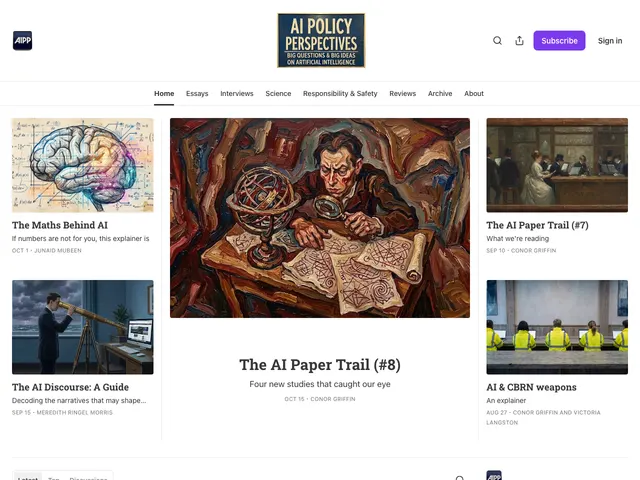
Conor Griffin and Tom Rachman · members of Google DeepMind's policy research team, writing in a personal capacity
Essays, interviews and reviews on AI policy, written by two Google DeepMind policy researchers explicitly in a personal capacity rather than for their employer. Covers AI's role in science and education, and societal effects on work, writing and culture.
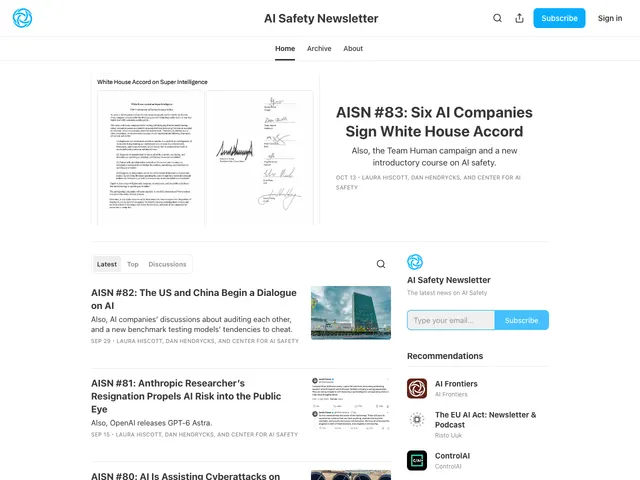
Laura Hiscott, Dan Hendrycks and the Center for AI Safety · Hendrycks is the Center for AI Safety's director
Roundup of AI-safety-relevant news, research and policy developments from the nonprofit behind the 2023 "Statement on AI Risk"; aimed at readers tracking the safety field without reading primary sources themselves.
Explainer essays on AI's resource use — data-centre energy and water consumption chief among them — and related effective-altruism topics, written to correct what the author sees as common public misconceptions, with calculations shown in full.
Essays on AI's trajectory and its implications for careers and effective-altruist priorities, written by a co-founder of the career-advice organisation 80,000 Hours; recent pieces have covered how to prepare for AGI timelines and what the Hugging Face security incident revealed about frontier-model risk.
Alex Kantrowitz · independent technology journalist, formerly of BuzzFeed News
Reporting and analysis on big technology companies and their effect on society, with AI infrastructure, compute spending and frontier-lab strategy as a recurring focus; paired with a weekly podcast.
Essays on AI safety practice, written by a researcher who worked on safety and policy at OpenAI before leaving in 2024; covers evaluation gaps, incident response and what frontier labs do and don't disclose.
Brendan McCord and contributors · founder of Cosmos Institute
Essays on the philosophy of AI from an organisation describing itself as an academy for "philosopher-builders", addressing autonomy, decentralisation and truth-seeking as design goals for AI systems rather than only as risks to manage.
Newsletter from a research group studying how advanced AI could reshape the long-run future, covering AI governance, economic transformation and existential risk, alongside a companion podcast, ForeCast.
Essays on AI regulation and governance in the United States, written by a researcher who has advised on state and federal AI policy. Known for detailed, deliberately literary-titled analysis of specific bills, executive actions and agency moves rather than news summary.
Gary Marcus · cognitive scientist and AI critic, professor emeritus at New York University
Frequent, often combative essays arguing that large language models' limitations are being underplayed by the industry, tracking failures, retracted claims and the gap between AI investment and demonstrated economic return.
Helen Toner · director of strategy at Georgetown's Center for Security and Emerging Technology, former OpenAI board member
Essays on AI policy and governance debates, including capability timelines and the limits of "AGI" as a category, written by a researcher who sat on OpenAI's board during Sam Altman's November 2023 removal and reinstatement. No new post since April 2026.
Steve Newman · chairman and president of the Golden Gate Institute for AI, co-founder of Writely (which became Google Docs)
Newsletter by a software entrepreneur that synthesises AI news into longer explanatory essays for a general audience, prioritising a coherent narrative over speed. Recent pieces have covered frontier-lab strategy, major model releases and AI-safety debates.
Owen Cotton-Barratt · mathematician and AI safety researcher
Essays reflecting on AI-safety research strategy and the psychology of working on long-horizon risk, written by a researcher affiliated with the effective-altruism and AI-safety research community.
Weekly AI newsletter from a mainstream technology-journalism outlet, aimed at demystifying AI developments for a general readership rather than specialists; one of several MIT Technology Review newsletters covering different beats.
Risto Uuk · head of European policy and research at the Future of Life Institute
Numbered newsletter and companion podcast tracking the European Union's AI Act from negotiation through enforcement, published by a researcher at the Future of Life Institute; aimed at compliance and policy readers following the law in detail.
a volunteer collective of graduate students, researchers and engineers
Nonprofit AI magazine founded by students and researchers at Stanford's AI Lab, publishing accessible but technically grounded essays, research overviews and interviews, plus a biweekly news digest and a podcast. Output has slowed markedly through 2026, with no new essay since February.
Daily digest of AI model releases, product launches and industry moves from the large labs, aimed at professionals at large companies rather than AI specialists; mixes short news items with explainers of what a release means in practice.
Peter Wildeford · co-founder of the Institute for AI Policy and Strategy (IAPS)
Essays on AI policy and risk assessment, written by a policy researcher whose institute advises governments on AI strategy; recurring themes include forecasting catastrophic risk and comparing it with more familiar hazards.
Daily digest of AI news and product launches aimed at a general professional audience, paired with practical "how to use this" guides and an associated podcast; covers model releases, agents and workplace applications.
Free weekday digest of AI model releases, research papers and developer tools, each item reduced to a one- or two-line summary with a link out. Pitched at engineers and technical professionals who want volume over narrative, in a "5-minute read".